
Automation's Reach Extends Across All Job Sectors, AI Leaders Warn
Leading artificial intelligence researchers and industry figures are sounding the alarm about widespread job displacement across all economic sectors, calling for urgent policy interventions and workforce adaptation strategies to mitigate automation's impact.
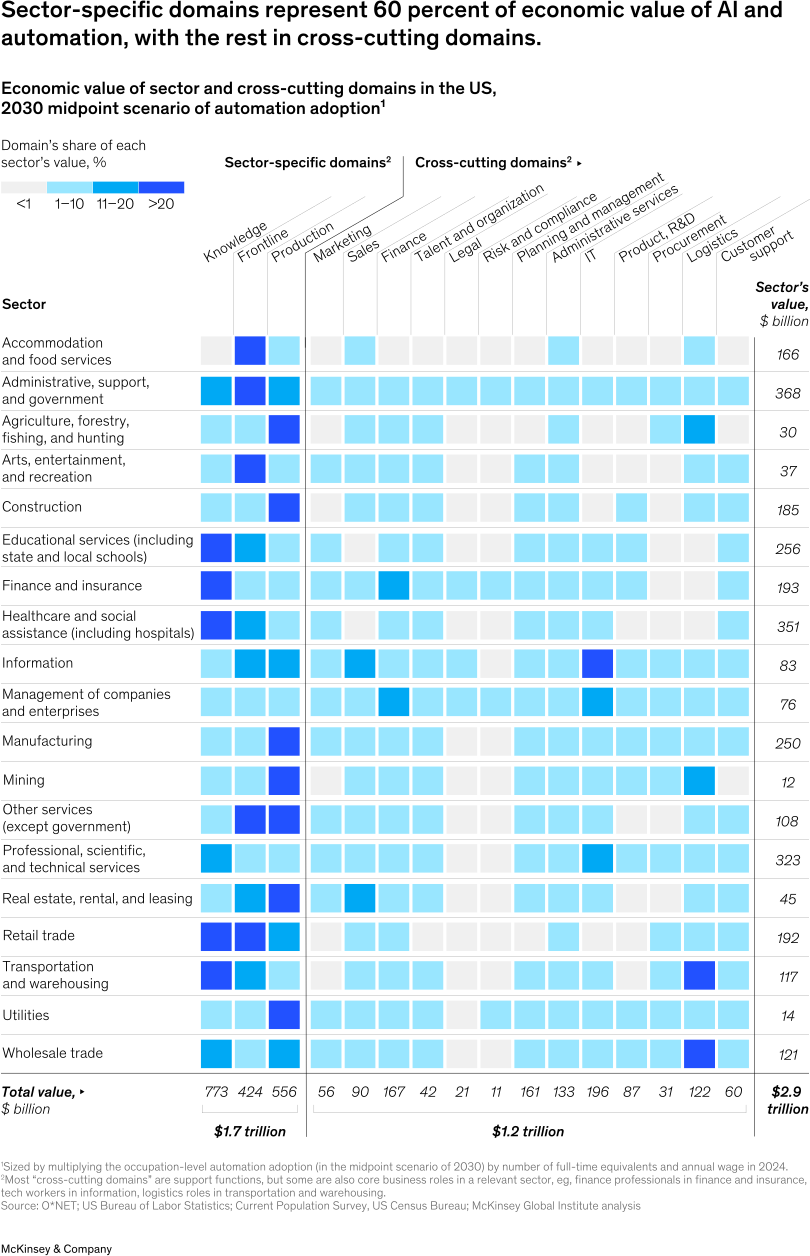
Automation's Reach Extends Across All Job Sectors, AI Leaders Warn
The consensus among prominent artificial intelligence researchers has shifted decisively: no occupation is immune to automation. As generative AI and robotic systems become increasingly sophisticated, industry leaders are emphasizing that the threat spans white-collar professions, manufacturing, service industries, and creative fields alike—demanding immediate action from policymakers and organizations.
The Scope of Disruption
Unlike previous waves of technological change that primarily affected manual labor, current AI capabilities threaten to displace workers across the entire employment spectrum. Machine learning models now perform complex analytical tasks, generate creative content, diagnose medical conditions, and manage financial portfolios with increasing accuracy. Simultaneously, robotic systems are advancing in dexterity and adaptability, expanding beyond factory floors into healthcare, logistics, and hospitality sectors.
The breadth of this disruption distinguishes it from historical precedent. When automation previously transformed industries, displaced workers could often transition to adjacent sectors. Today's generalized AI systems blur traditional occupational boundaries, creating uncertainty about which roles will remain fundamentally human-dependent.
Sectoral Vulnerability
Research indicates that vulnerability to automation spans multiple dimensions:
- Knowledge work: Data analysis, legal research, financial forecasting, and software development face significant displacement risk
- Healthcare: Diagnostic imaging, administrative tasks, and routine clinical assessments are increasingly automated
- Creative industries: Content generation, design iteration, and media production now leverage AI capabilities
- Manufacturing and logistics: Advanced robotics continue expanding beyond traditional assembly lines
- Service sectors: Customer service, scheduling, and routine problem-solving increasingly rely on automated systems
The Policy Imperative
Leading AI researchers emphasize that market forces alone will not address the resulting workforce disruption. Effective responses require coordinated action across multiple domains:
Education and reskilling represent critical infrastructure investments. Rather than training workers for specific roles vulnerable to automation, educational systems must emphasize adaptability, complex problem-solving, and uniquely human capabilities—creativity, emotional intelligence, and ethical reasoning.
Social safety nets require redesign to accommodate rapid occupational change. Traditional unemployment insurance and pension systems assume relatively stable career trajectories. Automation-driven displacement may necessitate portable benefits, income support mechanisms, and transition assistance that transcends single employers.
Regulatory frameworks must evolve to address automation's pace. Some researchers advocate for impact assessments before deploying transformative technologies, while others emphasize transparency requirements and worker notification protocols.
The Human-Machine Partnership Model
Rather than viewing automation as wholesale job replacement, some industry leaders propose collaborative frameworks where humans and AI systems work in complementary roles. This approach acknowledges that certain tasks—requiring judgment, interpersonal connection, or ethical decision-making—remain distinctly human domains, while routine cognitive and physical work becomes increasingly automated.
Implementing this partnership model requires deliberate organizational design and workforce development. Companies must invest in training workers to collaborate effectively with AI systems, rather than simply deploying automation to eliminate positions.
Urgency and Timeline
The acceleration of AI capabilities has compressed the timeline for adaptation. Unlike previous technological transitions that unfolded over decades, current AI advancement suggests significant workforce disruption within years rather than generations. This compressed timeline intensifies pressure on policymakers to act decisively.
Industry leaders stress that proactive measures implemented now—investment in education, policy innovation, and workforce transition support—can substantially mitigate negative outcomes. Conversely, delayed action risks creating concentrated economic hardship and social instability.
Key Sources
- McKinsey Global Institute research on agents, robots, and skill partnerships in the age of AI
- Ongoing industry analyses of sectoral automation vulnerability and workforce adaptation strategies
The challenge ahead is not whether automation will transform employment, but whether societies can implement thoughtful, equitable responses that preserve opportunity and dignity across economic sectors.
Tags
Enjoyed this article?
Get the top AI stories delivered to your inbox every week. No spam, just the news that matters.
Join our weekly newsletter. Unsubscribe anytime.