Netomi Integrates GPT-4.1 and GPT-5.2 for Enterprise AI
Netomi integrates GPT-4.1 and GPT-5.2 to enhance enterprise AI, offering scalable, reliable solutions for Fortune 500 companies.
Netomi Pioneers Enterprise-Scale Agentic AI with OpenAI's GPT-4.1 and GPT-5.2
Netomi, a leading provider of agentic AI platforms for customer experience (CX), has emerged as a blueprint for scaling reliable AI agents in Fortune 500 environments. The company leverages OpenAI's GPT-4.1 for low-latency tool use and GPT-5.2 for multi-step reasoning. This approach combines concurrency frameworks, strict governance, and production-grade orchestration to handle complex workflows like those at United Airlines and DraftKings, ensuring predictable performance under high loads. (OpenAI, Netomi)
Core Technology and Scaling Strategy
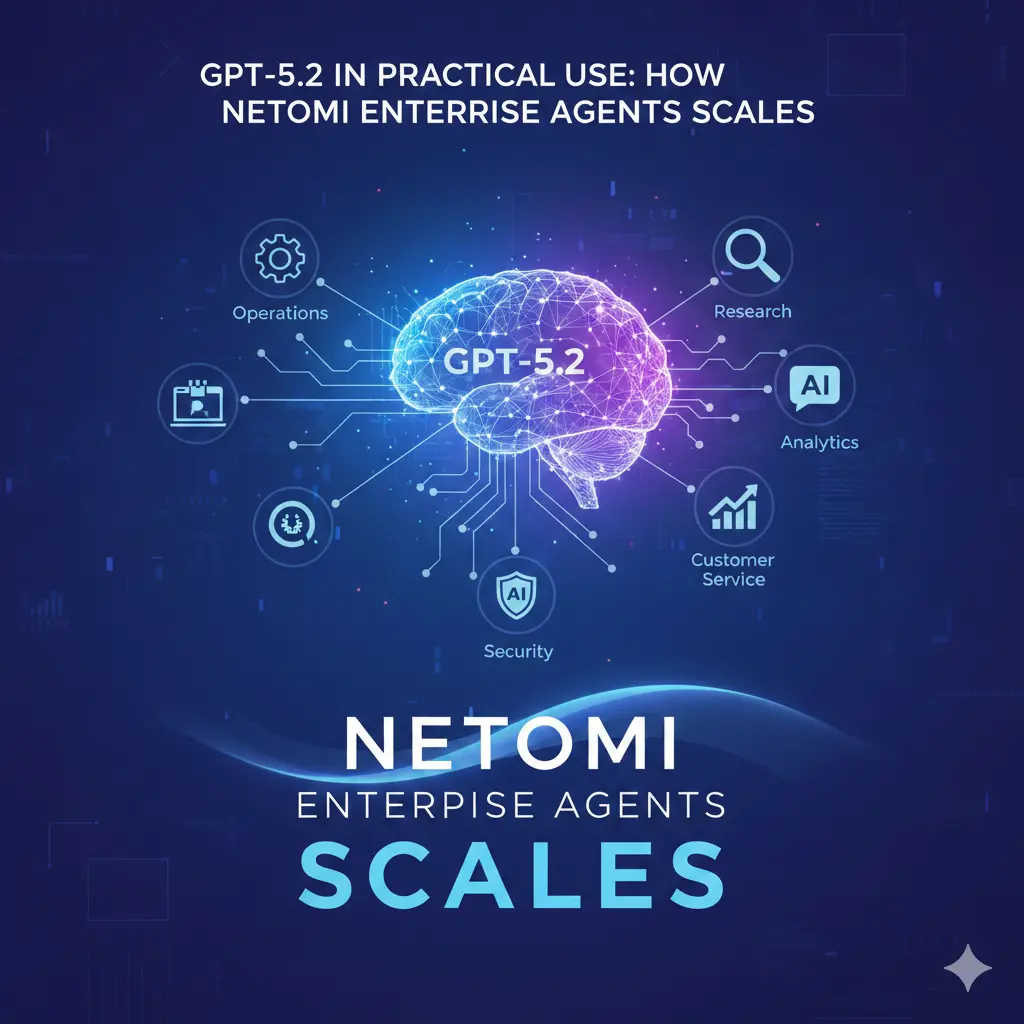
Netomi's platform integrates GPT-4.1—optimized for fast time-to-first-token and reliable tool-calling—with GPT-5.2 for deeper planning in extended tasks. This dual-model architecture runs within a governed execution layer that enforces consistency, preventing erratic behavior in real-world production. As detailed in OpenAI's feature on Netomi, the system parallelizes operations to maintain latency thresholds across the entire workflow, not just individual model calls. "Our goal was to orchestrate the many systems a human agent would normally juggle and do it safely at machine speed," the company states. (OpenAI)
This setup enables autonomous AI agents with situational intelligence, which interpret contexts, execute actions, and complete transactions across chat, email, voice, and messaging channels. Netomi emphasizes proactive orchestration, policy alignment, and real-time human-in-the-loop assistance for escalations, making it suitable for mission-critical CX. Fortune 500 clients like DraftKings praise its ability to manage "massive spikes in activity with agility and precision," according to Co-Founder Paul Liberman. United Airlines has similarly highlighted its potential to elevate chat experiences beyond traditional chatbots. (OpenAI, Netomi)
Netomi's concurrency model relies heavily on GPT-4.1's predictability, allowing multi-step workflows to remain responsive even at extreme scale. OpenAI positions this as a "blueprint" for startups aiming to deploy agentic systems enterprise-wide, stressing complexity handling, parallelization, and baked-in governance. (OpenAI)
Past Performance and Track Record
Netomi has built a proven track record in high-stakes industries. Trusted by Fortune 500 firms, it automates end-to-end inquiry resolution while integrating with CRMs, order systems, and billing tools. The platform's emphasis on brand-safe automation—grounding responses solely in approved enterprise data—has driven consistent performance across millions of interactions. (Netomi, Template)
Client testimonials underscore reliability. DraftKings notes that its collaboration with Netomi and OpenAI "redefines the speed and quality of experiences" for millions of customers, enhancing decisions and fan connections while upholding trust. United Airlines recently launched a Netomi-powered agentic capability, addressing longstanding chatbot limitations in complex sectors like aviation. These deployments demonstrate Netomi's evolution from basic automation to governed, scalable intelligence. (Netomi, OpenAI)
No major outages or failures are reported in recent coverage, with OpenAI's endorsement signaling maturity. Netomi's systems have scaled to handle proactive customer journeys "always on-policy," a feat validated by its #1 ranking for brand-safe AI at massive scale in 2026 chatbot evaluations. (Template)
Competitor Comparison
| Platform | Key Strengths | Weaknesses vs. Netomi | Best Use Case |
|---|---|---|---|
| Netomi | Enterprise governance, GPT-4.1/5.2 concurrency, full workflow automation across channels; strict data grounding. (OpenAI, Template) | Higher complexity for setup. | Fortune 500 CX with compliance needs. |
| Conversica | Natural email/messaging follow-ups, persistent conversations. (Template) | Less focus on multi-channel scale or deep reasoning. | Mid-sized teams for ticket reduction. |
| PartnerHero | Hybrid AI-human outsourcing, global scaling. (Template) | Relies on humans for complexity, not fully autonomous. | Companies without internal teams. |
| IBM Watson Assistant | Robust NLP, multilingual enterprise depth. (Template) | Slower innovation pace vs. OpenAI integrations. | Regulated, large-scale multilingual ops. |
| Chatbase | Custom training on docs/FAQs, no-code embeds. (Template) | Lacks governed multi-step agency. | Simple, website-based self-service. |
Netomi stands out for its agentic depth and OpenAI backbone, outperforming in autonomous resolution and latency under load. Competitors like Conversica excel in targeted engagement but fall short on full enterprise orchestration. (Template)
Why Now? Strategic Context and Market Timing
The timing aligns with surging demand for agentic AI amid 2026's CX transformation. Enterprises face pressure to automate complex interactions as customer volumes explode—DraftKings cites "moments that matter most" amid spikes. OpenAI's release of GPT-4.1 and GPT-5.2 provides the reasoning primitives needed for production reliability, which Netomi was engineered to exploit. (OpenAI, Netomi)
Broader trends include regulatory scrutiny on AI safety and the shift from reactive chatbots to proactive agents. Netomi's governed design addresses enterprise trust barriers, positioning it as enterprises adopt AI post-2025 model leaps. OpenAI's public blueprint endorsement accelerates adoption, signaling validated scalability. (OpenAI)
Skeptical voices are minimal in Tier 1 coverage, though general critiques of agentic systems note hallucination risks—mitigated here by Netomi's grounding and governance. Analysts view this as a maturing market, with Netomi leading for compliant scale. (Template)
Implications for Enterprise AI
Netomi's model offers a replicable path: pair advanced LLMs with systems engineering for auditable, low-latency agency. This could redefine CX, reducing human dependency while boosting precision. For startups, it underscores governance as key to monetization. As agentic systems proliferate, Netomi's Fortune 500 validation sets a high bar, potentially pressuring competitors to enhance reasoning and concurrency.
Visuals from sources include Netomi's hero image on OpenAI's page, depicting an abstract blueprint of interconnected AI workflows (scene-aware agents orchestrating channels), and platform screenshots on Netomi.com showing dashboard interfaces for agent monitoring and policy controls. (OpenAI, Netomi)
Tags
Enjoyed this article?
Get the top AI stories delivered to your inbox every week. No spam, just the news that matters.
Join our weekly newsletter. Unsubscribe anytime.