AI Is Real, But OpenAI's Path to Profitability Remains Uncertain
OpenAI has achieved remarkable technical breakthroughs, but faces mounting financial pressures and intensifying competition from Google and Amazon. Can the company survive its own ambitions?
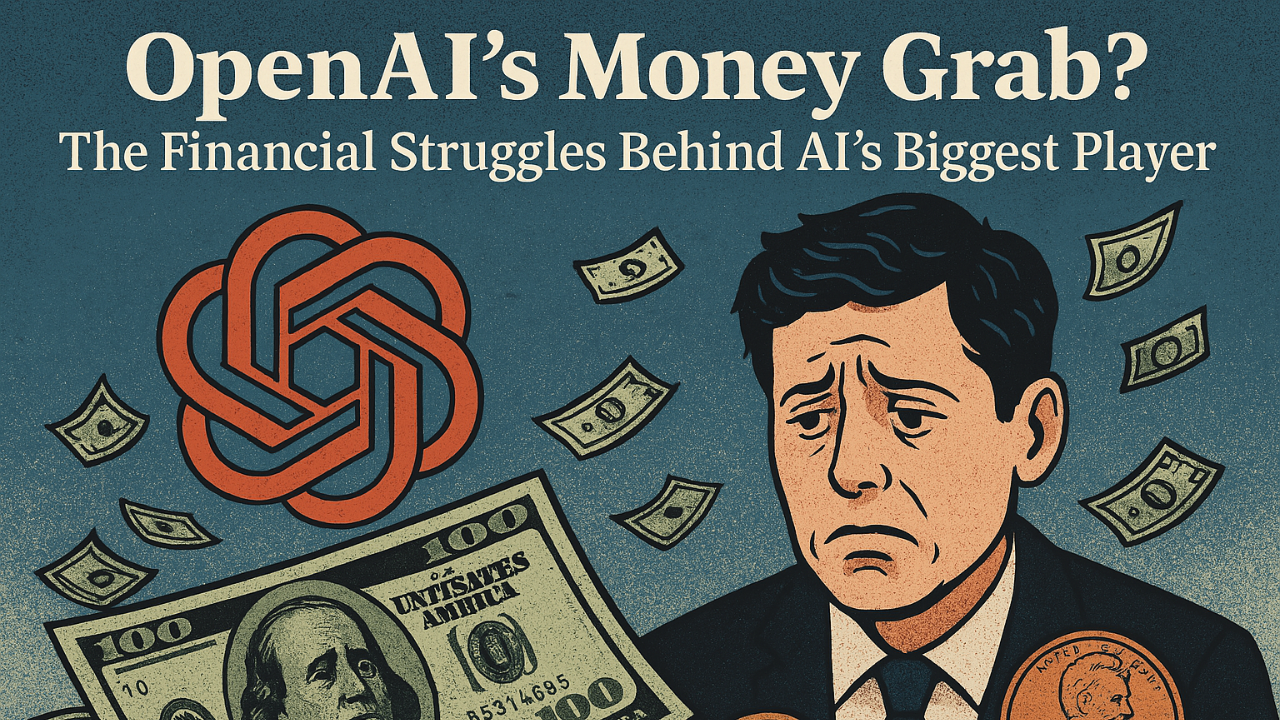
The AI Breakthrough Is Real—But So Are OpenAI's Problems
Artificial intelligence has moved from theoretical promise to practical reality. ChatGPT, GPT-4, and emerging multimodal systems demonstrate genuine capabilities that reshape how knowledge workers operate. Yet the company that sparked this revolution now faces an existential paradox: technical dominance doesn't guarantee business survival.
According to reporting from Axios, Google and Amazon are aggressively encroaching on OpenAI's market position, with both tech giants integrating AI into their core products and infrastructure. This competitive pressure arrives precisely when OpenAI must demonstrate it can convert technical leadership into sustainable revenue.
The Financial Reality Check
OpenAI's burn rate tells a sobering story. The company operates at massive losses while pursuing an increasingly capital-intensive roadmap. As detailed in analysis from Shailesh Sharma, OpenAI's 2026 strategy hinges on aggressive monetization—but the window to execute is narrowing.
The core challenge:
- Compute costs are astronomical: Training and running large language models requires billions in infrastructure investment
- Competition is accelerating: Google's Gemini and Amazon's AI initiatives threaten to commoditize AI capabilities
- Revenue models remain unproven: While enterprise adoption is growing, it hasn't yet offset operational expenses at scale
The Monetization Gamble
DigiDay's investigation into OpenAI's monetization strategy reveals the company is exploring advertising, premium tiers, and enterprise licensing to generate revenue. Yet each approach carries risk:
- Advertising integration could alienate users and degrade product quality
- Premium pricing faces resistance in a market where free alternatives (Google's Gemini, Meta's Llama) are improving rapidly
- Enterprise licensing requires sustained differentiation that competitors are actively eroding
Healthcare and Beyond: Expansion or Distraction?
OpenAI's recent healthcare initiative signals ambitions to diversify revenue beyond consumer and general-purpose enterprise markets. Healthcare represents a high-margin opportunity—but also demands regulatory compliance, clinical validation, and deep domain expertise that OpenAI is still building.
The question: Is this strategic expansion or a desperate search for any revenue stream that sticks?
The Structural Vulnerability
OpenAI's predicament reflects a fundamental tension in AI economics:
- Scale requires capital: Larger models demand exponentially more compute, driving costs higher
- Commoditization is inevitable: As AI capabilities become table stakes, pricing power erodes
- First-mover advantage is temporary: Technical leads in AI compress faster than in previous software cycles
Unlike traditional software companies that achieve profitability through operational leverage, AI companies face a treadmill: continuous reinvestment in compute just to maintain competitive parity.
What Happens Next?
OpenAI's survival depends on three factors:
- Achieving genuine product-market fit at scale (not just among early adopters)
- Maintaining technical differentiation while competitors close the gap
- Reaching profitability before capital markets lose patience with the burn rate
The company has proven AI is real. What remains unproven is whether OpenAI can build a durable, profitable business around it. The next 18 months will be decisive.
Tags
Enjoyed this article?
Get the top AI stories delivered to your inbox every week. No spam, just the news that matters.
Join our weekly newsletter. Unsubscribe anytime.