OpenAI Releases GPT-Image-1.5 for Enhanced Image Generation
OpenAI launches GPT-Image-1.5, enhancing image generation and editing with improved detail and speed, available for ChatGPT users and developers.
OpenAI Releases GPT-Image-1.5 for Enhanced Image Generation
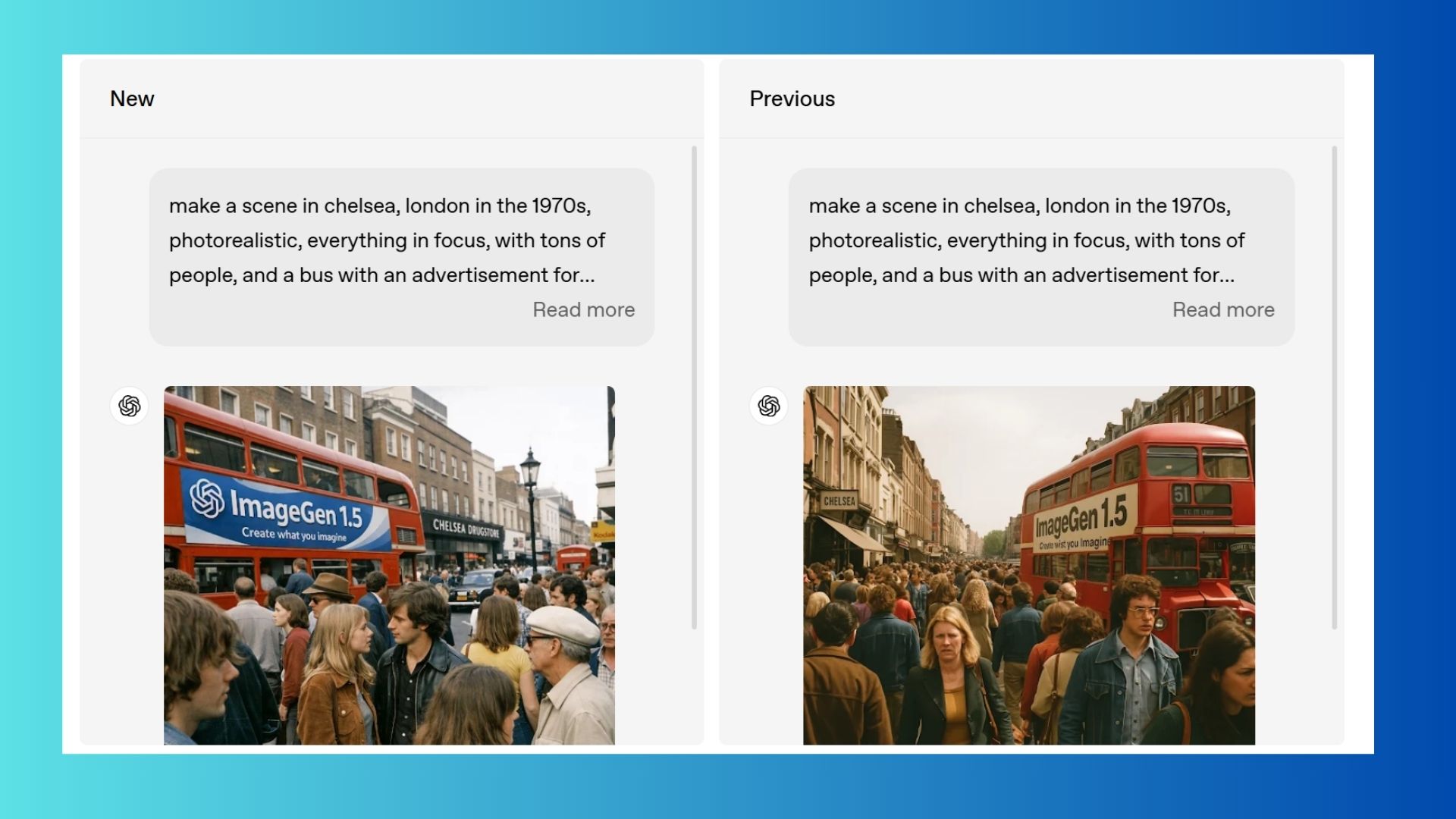
The new ChatGPT Images rollout introduces a faster, more capable image-generation and editing experience to ChatGPT users and developers, powered by OpenAI’s upgraded image model — GPT-Image-1.5. OpenAI claims this model produces clearer details, more accurate edits, and up to four times faster generation than the previous model. This release is available to ChatGPT users immediately and is accessible to developers via the API, extending the company’s visual capabilities across consumer and third-party applications.
Background
OpenAI has been steadily integrating stronger vision capabilities across its model family, pairing multimodal perception with text and agentic tools to support real-world workflows. The GPT-Image-1.5 update follows that trajectory: it is an image-focused upgrade intended to improve fidelity, editing precision, and throughput for image generation tasks inside ChatGPT and for API consumers. The new image model appears alongside other recent model improvements in OpenAI’s product line that emphasize speed and higher accuracy on visual tasks.
What’s New in GPT-Image-1.5 / ChatGPT Images
- Higher fidelity and more consistent details: OpenAI describes GPT-Image-1.5 as delivering “more precise edits” and “consistent details,” addressing common weaknesses of earlier image models where small features or fine textures could be inconsistent across generated variations.
- Faster generation: The model reportedly generates images up to 4× faster compared to the prior image model, which reduces latency for interactive editing and rapid iteration within ChatGPT and client apps using the API.
- Editing improvements: The update focuses on editing workflows — e.g., inpainting or localized edits — enabling users to refine images with greater control and fewer unintended artifacts, a key capability for designers, marketers, and creators.
- API availability: GPT-Image-1.5 is available as an API model, allowing developers to integrate the upgraded image-generation and editing capabilities into third-party tools, automation workflows, and creative apps.
How This Fits into OpenAI’s Wider Vision Roadmap
OpenAI’s contemporaneous model announcements emphasize both general intelligence improvements and enhanced vision features. For instance, GPT‑5.2 — a separate family release focused on multimodal reasoning — improves chart reasoning and interface understanding, indicating a company strategy to strengthen vision across both perception and generation tasks. GPT-Image-1.5 represents the generation/editing arm of that broader push, complementing vision advances in models designed for interpretation and reasoning.
Practical Implications and Likely Uses
- Creators and designers: Faster generation and improved edit precision reduce iteration time when producing marketing visuals, concept art, or social-media content, enabling more rapid prototyping and fewer manual corrections.
- Productivity tools and agencies: Integration via the API lets SaaS vendors embed higher-quality image editing and generation into design platforms, document composition, or campaign-creation tools.
- Accessibility and content enrichment: The improved model could power richer image-based assistance inside ChatGPT, enhancing workflows across education, documentation, and customer support.
- Risks and considerations: As with any more capable image model, there are policy, misuse, and copyright considerations around synthetic imagery, deepfakes, and the reproduction of copyrighted or private content; platform-level safeguards, content policy enforcement, and watermarking practices will be important to mitigate misuse.
Industry and Developer Reaction
Developer and analyst commentary on upgrades like GPT-Image-1.5 typically highlights two themes: the value of lower latency for interactive apps and the commercial opportunity in embedding high-quality, low-cost image generation across verticals. Early technical writeups and blog posts emphasize the model’s speed and edit fidelity as differentiators from prior offerings.
Context and Implications
OpenAI is pushing both perception (ability to understand images) and generation (ability to create images) in parallel, which can unlock new end-to-end workflows where systems both analyze visual inputs and produce high-quality visual outputs in the same session. This convergence enables features like visually grounded agents, automated UX mockups from text prompts, and smarter assistive editing in consumer products. However, the balance between innovation and safety remains central: as image models become faster and more photorealistic, platform policies, provenance signals, and developer guidelines will play a decisive role in shaping responsible adoption.
Key Takeaway
GPT-Image-1.5, released as the engine behind the updated ChatGPT Images feature, elevates image generation and editing with improved detail consistency and significant speed gains, and is available to both ChatGPT users and API developers — positioning OpenAI to broaden practical, image-centric use cases while renewing attention on governance and safe deployment.
Images to Accompany This Article
- Official OpenAI/ChatGPT product announcement screenshot or header image from OpenAI’s announcement page showing the “new ChatGPT Images” branding.
- Sample before/after edit demonstrations or API demo screenshots labeled GPT-Image-1.5.
- OpenAI logo or ChatGPT logo to identify the company and product.
Note: Please ensure all images used are licensed or attributed per the providers’ terms; prefer official OpenAI assets from their announcement and API documentation for accurate representation.
Tags
Enjoyed this article?
Get the top AI stories delivered to your inbox every week. No spam, just the news that matters.
Join our weekly newsletter. Unsubscribe anytime.