
VideoRAG: How Video-Powered Knowledge Retrieval Is Reshaping Enterprise Search
VideoRAG combines retrieval-augmented generation with video analysis to unlock knowledge trapped in video content. Learn how this emerging technology transforms how organizations search and share information across multimedia archives.
The Video Knowledge Gap
Organizations are drowning in video content. Training recordings, conference presentations, customer testimonials, and internal documentation sit locked in video files—accessible only through manual scrubbing and human memory. While text-based retrieval systems have matured over decades, video remains largely unsearchable. VideoRAG changes that equation by applying retrieval-augmented generation (RAG) principles directly to video data, enabling machines to understand, index, and retrieve knowledge from visual content with unprecedented precision.
This shift matters because according to industry analysis, organizations waste significant resources re-creating knowledge already captured on video. The gap between what exists and what's discoverable represents a massive inefficiency—one that VideoRAG is designed to close.
What Is VideoRAG?
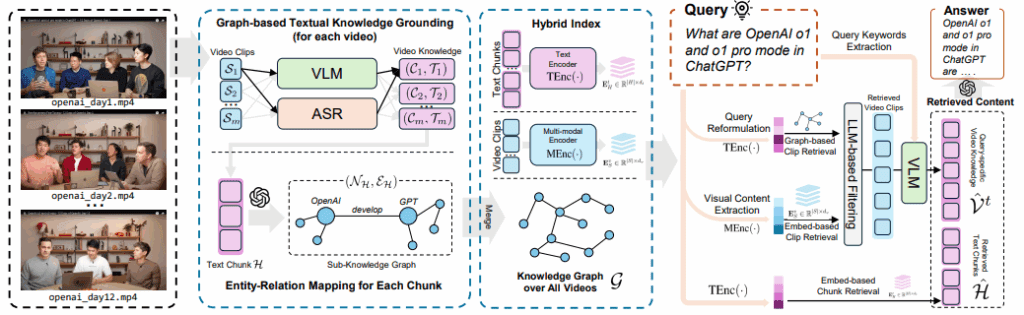
VideoRAG extends the RAG framework—a technique that grounds AI responses in retrieved documents—to handle video as a first-class knowledge source. Rather than treating video as opaque blobs, the system breaks down video into semantic components: visual scenes, spoken dialogue, text overlays, and temporal relationships.
Research published on arXiv demonstrates that VideoRAG architectures employ multi-modal indexing to create searchable representations of video content. The process typically involves:
- Frame extraction and analysis: Sampling key frames and analyzing visual content
- Speech-to-text transcription: Converting audio dialogue into searchable text
- Semantic embedding: Creating vector representations that capture meaning across modalities
- Temporal indexing: Preserving when information appears in the video timeline
This allows queries like "Show me how to configure the API authentication" to retrieve the exact 2-minute segment from a 45-minute training video, complete with timestamp.
Enterprise Applications
The practical impact extends across multiple domains:
Knowledge Management: Organizations can build searchable repositories of institutional knowledge without manual transcription. Production video search infrastructure now handles millions of hours of content, making video archives as discoverable as document databases.
Training and Onboarding: New employees can query video libraries directly. Instead of "watch these 10 videos," systems can surface the 5-minute segment most relevant to their current task.
Customer Support: Support teams can instantly retrieve product demonstration videos matching customer questions, reducing response time and improving consistency.
Content Repurposing: Marketing and training teams can identify and extract clips from longer recordings, accelerating content creation workflows.
Technical Challenges
Implementing VideoRAG at scale introduces complexity. Multi-modal RAG systems must balance accuracy across different data types—visual understanding, speech recognition, and text analysis each introduce potential errors that compound.
Key technical hurdles include:
- Computational cost: Processing hours of video requires significant infrastructure investment
- Accuracy degradation: Errors in speech recognition or visual analysis propagate through the retrieval pipeline
- Temporal precision: Identifying exact moments within video requires frame-level accuracy
- Context preservation: Maintaining narrative context across video segments
The Emerging Ecosystem
The field is moving rapidly. Demonstrations of agentic video RAG systems show how VideoRAG can be combined with autonomous agents to perform complex tasks—not just retrieving information but acting on it.
Vendors and researchers are building specialized infrastructure to handle video at scale. The convergence of improved video understanding models, cheaper compute, and standardized RAG frameworks is making VideoRAG increasingly practical for organizations beyond research labs.
What's Next
VideoRAG represents a fundamental shift in how organizations treat video content: not as passive media for human consumption, but as structured knowledge that machines can understand and retrieve. As video libraries grow and retrieval accuracy improves, expect VideoRAG to become standard infrastructure for any organization managing significant video assets.
The organizations that crack video knowledge retrieval first will gain a competitive advantage in speed, consistency, and employee productivity. For others, the gap between searchable text and unsearchable video will only become more costly to ignore.
Tags
Enjoyed this article?
Get the top AI stories delivered to your inbox every week. No spam, just the news that matters.
Join our weekly newsletter. Unsubscribe anytime.